
- info@adti.uz
- (0-374) 223-94-60
- Yu.Otabekov 1. Andijan city



Value the quality of the educational process and always strive for it.
To educate highly qualified medical professionals with creative thinking, based on modern educational requirements, international best practices, and labor market needs. Department motto
The Department assesses and analyzes students’ learning outcomes, monitors the quality of education, conducts internal quality assessments, identifies and eliminates factors that adversely affect educational quality, and contributes to the preparation of competent, competitive, and modern healthcare professionals.
Value the quality of the educational process and always strive for it.
The Department of Education Quality Control at Andijan State Medical Institute was established in accordance with Paragraph 14 of Resolution No. 515 of the Cabinet of Ministers of the Republic of Uzbekistan dated July 18, 2017.
The Department operates in accordance with the Constitution and the Law “On Education,” presidential and government acts, directives of the relevant ministries and agencies, orders of the ASMI Rector, and the department’s regulations.
Under Presidential Decree No. UP-76 of May 5, 2025 and Cabinet Resolution No. 498 of August 6, 2025, the National Agency for Quality Assurance in Education and quality assurance departments in state higher education institutions were established. The department operates autonomously and reports directly to the head of the institution and authorized bodies.
Systematic quality control, analysis, and continuous improvement of education.
Monitor the quality of personnel training and analyze students’ compliance with state educational standards and their mastery of academic disciplines.
Build a teaching staff capable of ensuring educational quality and create transparent mechanisms for selecting, hiring, and developing qualified faculty.
Regularly analyze teaching quality, organize internal assessment, and take measures to eliminate identified shortcomings.
Ensure the educational process complies with regulations and analyze whether qualifications, curricula, and programs meet professional standards and labor market needs.
Develop comprehensive conclusions on graduates’ position in the labor market, demand for their skills, and the viability of relevant fields.
Review the use of modern pedagogical and information technologies and the effectiveness of quality control in the teaching process.
Review the involvement of qualified specialists from industry and practical fields in teaching.
Assess the effectiveness of measures taken to ensure transparency and impartiality in evaluating students’ knowledge.
Review faculty professional development and the incorporation of scientific innovations into academic programs.
Analyze the fair distribution of teaching workloads among faculty members.
Review conditions and textbook availability in the information resource center and submit recommendations to management.
Study and analyze the organization of independent learning, including methodological guidance, requirements, and student workload formation.
At the request of authorized state bodies, the Department also participates in reviewing the activities of other higher education institutions.
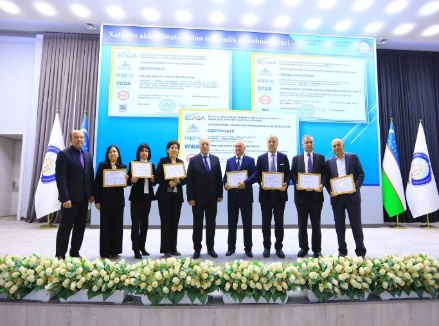
In 2024, the “General Medicine” (60910200) and “Dentistry” (60910100) programs underwent international accreditation. In 2025, accreditation was secured for the Master’s specialties in Obstetrics and Gynecology, Medical Radiology, Cardiology, General Oncology, and General Surgery in Uzbek, Russian, and English. Five-year certificates were issued for January 29, 2026 through January 28, 2031.
The new Bachelor’s program in Biomedical Engineering (60711100) and Master’s specialty in Dermatovenereology (70910208) successfully underwent special state accreditation.
A working group analyzed faculty performance for 2025 across teaching, instructional-methodological, research, spiritual-educational, and faculty-student mentoring activities. The results were discussed by the Institute and Faculty Councils.
In accordance with the regulations on the national ranking of higher education institutions, the department prepared data on the Institute’s activities and submitted it to the National Agency for Quality Assurance in Education.
The Department regularly submits reports to the Institute Rector on the fulfillment of tasks specified in its regulations.
Department activities, assessment processes, and accreditation results.